You have 0 items in your cart
Nusa Penida is one of Bali’s most well-known diving destinations, attracting divers with its diverse marine life, dramatic underwater landscapes, manta rays, and seasonal sightings of ocean sunfish (mola-mola). Popular dive sites include Manta Point, Crystal Bay, Blue Corner, Gamat Bay, Toyapakeh, and SD Point.
However, the oceanographic conditions that make Nusa Penida exciting can also create challenging diving environments. Currents around the island can vary in strength and direction, making proper dive planning, communication, situational awareness, and emergency preparedness essential.
Safe diving in Nusa Penida is not simply about having the correct equipment. Divers and dive professionals need to understand local conditions, recognize changes in current, maintain awareness of their surroundings and group, and have a clear plan for unexpected situations.
Understanding Currents in Nusa Penida
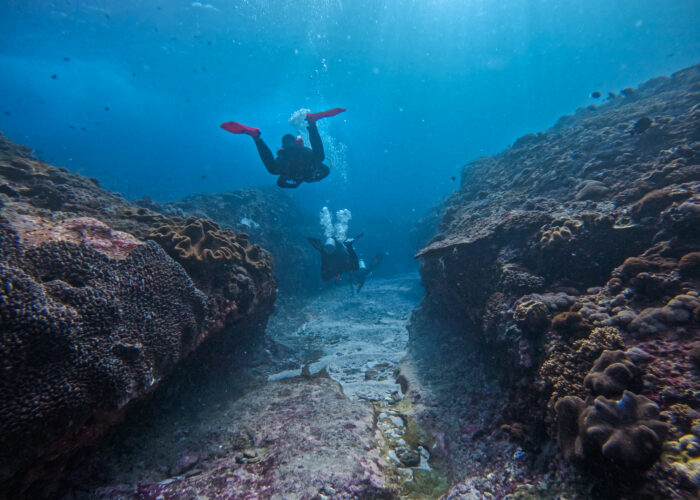
Current is one of the most important environmental factors when diving around Nusa Penida. Many dive sites are experienced as drift dives, where divers allow the current to carry them along the reef rather than continuously swimming against it.
SD Point, or Mangrove Point, for example, is commonly experienced as a drift dive. Divers are generally carried by the current while observing the reef and marine life along the route.
Currents are not always consistent throughout the water column. Their speed and direction can change depending on depth, tides, underwater topography, and local conditions. A current at the surface may also be different from what a diver experiences at depth.
A calm-looking surface does not necessarily mean calm conditions underwater.
For this reason, every current dive should begin with a site-specific briefing covering the expected current, entry method, route, depth, communication signals, separation procedures, ascent plan, and boat pickup procedure.
Dive Planning and Pre-Dive Briefing
A safe dive begins before entering the water. The dive team should consider:
Environmental conditions:
Tide and current predictions, weather and sea conditions, visibility, water temperature, and site-specific hazards.
Diver factors:
Certification and experience, recent diving activity, physical and mental condition, experience with current diving, and comfort level with the planned site.
BCD and regulators, dive computer, SMB and reel when appropriate, signaling devices, and suitable exposure protection.
Emergency preparedness:
Emergency Action Plan (EAP), oxygen availability, communication procedures, boat emergency equipment, local emergency contacts, and evacuation or medical referral procedures.
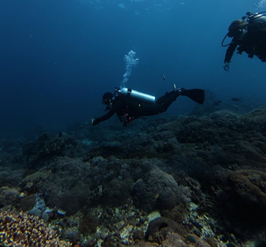
Listen to Your Dive Guide
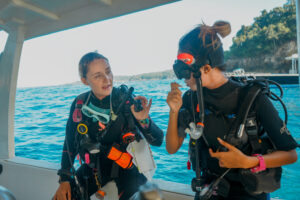
Before entering the water, listen carefully to the briefing given by your dive guide or dive professional. The briefing is not just a routine before the dive; it is an important part of your safety preparation.
Make sure you understand the dive site, expected current, planned route, depth limits, communication signals, separation procedures, ascent plan, and boat pickup procedure.
If anything is unclear or you have a question, do not hesitate to ask. Dive guides and dive professionals are there to provide information and answer questions before the dive begins.
There is no such thing as a silly question when it comes to diving safety. It is better to ask before entering the water than to be uncertain once you are underwater.
Drift Diving: Work With the Current
One of the most important principles of drift diving is to avoid unnecessarily fighting the current. Continuously swimming against a strong current can increase physical exertion, fatigue, and breathing-gas consumption.
During a drift dive, divers should:
- Maintain awareness of their buddy and group.
- Keep a streamlined body position.
- Monitor depth, time, and gas supply.
- Avoid unnecessary swimming against the current.
- Maintain good buoyancy control.
- Follow the planned route and instructions from the dive professional.
- Be prepared to deploy an SMB when appropriate.
The objective is not to “beat” the current, but to manage the dive so that the current remains part of the plan.
Recognizing Changes in Current
Currents can become stronger or change direction during a dive. Divers should pay attention to early warning signs, including:
- Increasing difficulty maintaining position.
- Rapid or unexpected changes in depth.
- Movement away from the planned route.
- Increasing breathing rate or gas consumption.
- Difficulty maintaining contact with the group.
- Sudden changes in visibility or water movement.
- Uncontrolled movement toward deeper water or the surface.
Recognizing these signs early gives divers more options to respond safely. If conditions become significantly different from those expected during the briefing, the dive plan should be reassessed.
A dive does not have to continue simply because it has already started.
Down-current and Vertical Water Movement
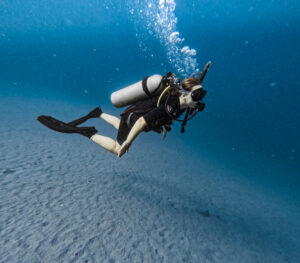
One of the more challenging current-related situations is a down-current or downwelling, where water movement carries a diver downward. Vertical currents can behave differently from ordinary horizontal drift currents and may be influenced by underwater structures, topography, and other water movements.
If a diver experiences unexpected downward movement, remaining calm is critical. The diver should continue breathing normally, monitor depth and gas supply, and respond according to their training and the site’s emergency procedures.
There is no single technique that is appropriate for every down-
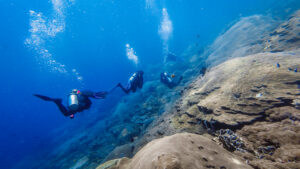
current situation. The response may depend on depth, current strength, topography, visibility, equipment configuration, diver experience, buoyancy control, and decompression status.
Therefore, current-related emergencies should be addressed through appropriate training and site-specific procedures, rather than relying on one universal “escape technique.”
Conclusion
Nusa Penida offers extraordinary diving, but its underwater environment requires respect, preparation, and appropriate experience.
Strong or changing currents do not automatically mean that a dive is unsafe. With appropriate training, careful planning, effective communication, suitable equipment, good situational awareness, and strong emergency procedures, current diving can be managed more safely.
The most important lesson is simple:
Good dive safety is not about eliminating every risk. It is about recognizing risks early, preparing for them, and making appropriate decisions when conditions change. For every dive in Nusa Penida, the goal should always be the same:
Return every diver safely to the boat, the shore, and home.