You have 0 items in your cart
The Secret Behind Tides Every Diver Should Know
Why Understanding Ocean Tides Matters Before You Dive
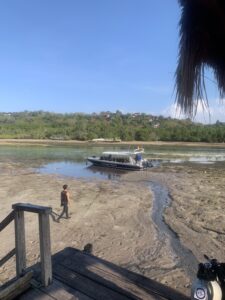
Have you ever arrived at a dive site where the ocean looked calm, only to find the current suddenly became strong a few hours later? That’s not a coincidence. The ocean moves in harmony with the rhythm of the universe, driven mainly by the gravitational pull of the Moon and the Sun on Earth’s waters, a phenomenon we know as tides.
According to the National Ocean Service (NOAA), tides occur due to the gravitational attraction of the Moon, which causes the ocean’s water to bulge on the side facing the Moon and on the opposite side of the Earth. As the planet rotates, the area where we stand passes through these bulges of water, making sea levels rise and fall periodically.
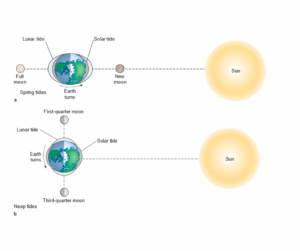
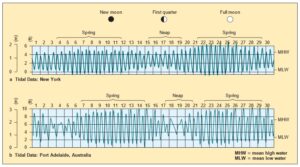
The Relationship Between the Earth, Moon, and Sun in Tidal Phenomena. (Top) shows the relative positions of the Moon and the Sun, while (bottom) illustrates the lunar configurations during tidal conditions in a) New York and b) Adelaide (Garrison, 2009).
Two Main Types: Spring Tide & Neap Tide
Throughout one lunar month (about 29.5 days), the positions of the Earth, Moon, and Sun constantly change.
- During the Full Moon and New Moon, the three bodies align. Their combined gravitational forces create spring tides, where high tides are higher and low tides are lower than usual. This is when ocean currents tend to be strongest.
- During the First Quarter and Last Quarter, the Moon’s position is at a right angle to the Sun relative to Earth. Their gravitational pulls counteract each other, producing neap tides, when the currents are calmer.
These tidal shifts can occur twice a day, though their intensity depends on the Moon’s phase. That’s why experienced divers always check the lunar calendar and tide tables before entering the water.

Why It Matters for Divers
Understanding tides isn’t just theoretical, it’s about safety and comfort underwater.
- Currents can change dramatically between spring and neap tides.
- Visibility is often better when currents are calm.
- Entry and exit points are easier to access when sea levels are stable.
In areas such as Ceningan, Lembongan, and Nusa Penida, currents around the full moon can become exceptionally strong, especially in sites like Mangrove, Crystal Bay, and Toyapakeh.
Divers who understand these patterns know the best times to dive safely, without fighting against the power of the ocean.
How to Read the Tides
To understand tidal patterns, we can use a variety of easily accessible resources, official tide tables, marine weather apps, and lunar calendars. These tools provide general insights into the timing and height of sea levels in a given area. By regularly observing these changes, we can predict when the currents will be calm or begin to strengthen, valuable knowledge for anyone working or playing at sea, from divers to fishermen.
Reading the Ocean’s Language
Understanding tides means learning to move in sync with nature, to read the ocean’s signs before stepping further. Every change in the current is not just a challenge for divers but a reminder that the sea has its own rhythm that deserves respect. By recognizing these natural cycles, we not only protect ourselves but also contribute to preserving the marine ecosystem that sustains us. It’s a small yet meaningful step toward more sustainable ocean activities, where knowledge becomes the key to loving the sea the right way.
Dive into Adventure and Conservation in Nusa Penida
Get ready to experience the magic of diving in Nusa Penida Marine Park Area —where vibrant coral reefs, exhilarating drift dives, and breathtaking marine encounters await!
Nestled within a thriving Marine Protected Area (MPA), the waters surrounding Nusa Penida, Nusa Lembongan, and Nusa Ceningan offer some of the most biodiverse and ecologically significant dive sites in Indonesia.
From soaring along gentle walls to riding the currents on thrilling drift dives, every site reveals a new facet of the underwater world. Whether you’re hunting for macro critters or scanning the blue for pelagic life, we have it all.
References:
Garrison, T. 2009. Waves. In Essential of Oceanography. California: Brooks/Cole Cengage Learning.
https://oceanservice.noaa.gov/education/tutorial_tides/tides03_gravity.html?utm_source=chatgpt.com